 EN
EN

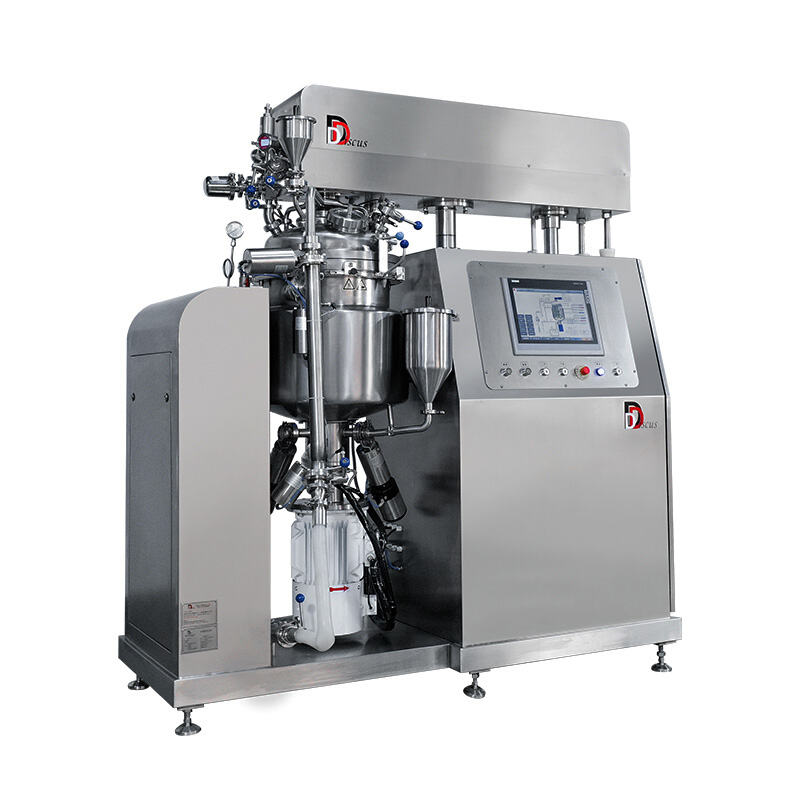
What Is a Homogenizer Mixer Machine? Core Principles and Key Types
At its core, a homogenizer mixer machine reduces particle size and creates uniform mixtures using intense mechanical force. Industries from pharmaceuticals to food processing rely on these machines to achieve microscopic consistency in emulsions, suspensions, and dispersions.
Mechanical vs. High-Pressure Homogenization Mechanisms
Mechanical homogenizers employ rotor-stator systems: a high-speed rotor spins within a stationary stator, generating shear forces that break down particles to 1–2 microns—ideal for medium-viscosity products like creams. In contrast, high-pressure homogenizers force materials through narrow valves at pressures up to 25,000 psi, leveraging turbulence and cavitation to achieve sub-micron particle reduction. This makes them essential for applications demanding nanoscale uniformity, such as dairy processing or vaccine suspensions.
Key Fact: High-pressure systems can reduce particle sizes 10× smaller than mechanical methods but consume 30% more energy (Industry Processing Journal, 2023).
Common Configurations: Inline, Batch, and Ultrasonic Homogenizer Mixer Machines
- Inline homogenizers integrate directly into production pipelines for continuous processing, minimizing downtime and ensuring consistent output.
- Batch units handle smaller volumes in tanks, offering flexibility for R&D, pilot trials, or low-output runs.
- Ultrasonic homogenizers use high-frequency sound waves to agitate materials—making them especially effective for heat-sensitive compounds like enzymes or labile biologics.
Critical Application Requirements for Homogenizer Mixer Machine Selection
Viscosity, Particle Size, and Throughput Demands by Industry
Selecting the right homogenizer mixer machine hinges on three interdependent parameters: viscosity, target particle size, and throughput. Viscosity dictates required shear force—pharmaceutical nanoemulsions demand stability at 15,000–30,000 cP, while dairy blends operate comfortably at 500–10,000 cP. Particle size targets vary by sector: cosmetics require ≤5 μm for texture consistency; pharmaceuticals target 0.1–1 μm for bioavailability; and chemical slurries may tolerate 50–100 μm. Throughput scales accordingly—biotech batches often run at 100–500 L/hr, whereas food manufacturing sustains 1,000–5,000 L/hr in continuous mode. Notably, halving particle size below 10 μm increases energy consumption by 18–22%.
| Industry | Viscosity Range | Target Particle Size | Throughput Benchmark |
|---|---|---|---|
| Pharmaceuticals | 15,000–30,000 cP | 0.1–1 μm | 100–500 L/hr |
| Food & Beverage | 500–10,000 cP | 2–20 μm | 1,000–5,000 L/hr |
| Cosmetics | 1,000–15,000 cP | 1–5 μm | 200–1,000 L/hr |
Material Compatibility and Sanitary Design Considerations
Material compatibility governs equipment longevity and contamination risk. Stainless steel 316L is standard for most acidic or neutral formulations, but aggressive chemistries—such as chlorine-based solutions—require corrosion-resistant coatings like Hastelloy C-276. Sanitary design must meet rigorous industry benchmarks:
- Electropolished surfaces (Ra ≤ 0.4 μm) to eliminate bacterial harborage
- Full drainage capability with slopes ≥2°
- Tri-clamp fittings compliant with 3-A Sanitary Standard 05-07
Validation standards—including EHEDG for European food production and ASME BPE for biopharma—ensure regulatory readiness. Non-compliant designs increase maintenance costs by 35% and raise contamination-related recall risk by 90%.
Performance Metrics That Define a High-Efficiency Homogenizer Mixer Machine
Evaluating homogenizer mixer machine performance requires monitoring three critical operational benchmarks. Consistent measurements directly impact product uniformity, scalability, and total cost of ownership across pharmaceutical, food, and chemical sectors.
Shear Rate, Pressure Stability, and Energy Efficiency Benchmarks
Shear rate (measured in s⁻¹) determines particle size reduction capability—units exceeding 50,000 s⁻¹ reliably produce nanoemulsions. Pressure stability during continuous operation prevents droplet recombination; fluctuations beyond ±5% compromise emulsion integrity. Energy efficiency is quantified as kW·h/ton processed, with leading models achieving 15–20% reductions via optimized rotor geometries and variable-frequency drives. These metrics form an integrated sustainability triad—high shear performance no longer necessitates disproportionate power consumption.
Maintenance Frequency and Mean Time Between Failures (MTBF)
Maintenance frequency reflects seal and valve durability: top-performing homogenizers require servicing only every 500–800 operational hours. MTBF (Mean Time Between Failures) remains the definitive reliability indicator—industrial-grade machines average 25,000–30,000 hours before major component replacement. Operations recording MTBF below 10,000 hours experience 37% higher downtime costs, per industry-wide processing analyses. Unlike repair cost alone, MTBF captures the full impact of unplanned stoppages on line efficiency and batch continuity.
Integrating a Homogenizer Mixer Machine into Your Production Line
Seamless integration hinges on strategic placement, connectivity, and sanitation protocols. Position the unit downstream from pre-mixing tanks but upstream of filling stations to support continuous processing. Ensure electrical and utility hookups comply with local codes, and validate piping interfaces—including CIP/SIP connections—against recognized sanitary standards like EHEDG or 3-A.
For automation, synchronize PLCs with SCADA systems using OPC UA or other industry-standard protocols. Implement redundancy—such as dual homogenizers with failover controls—for shear-sensitive products to prevent line-wide halts. Always commission equipment using material trials that replicate actual batch viscosity profiles.
Post-integration, benchmark OEE (Overall Equipment Effectiveness) against baseline metrics and monitor thermal stability during extended runs to detect early wear in seals or rotors. Scale incrementally: pilot-test configurations ≤500 L before expanding to high-volume lines to avoid costly retrofits.
| Integration Priority | Impact on Production | Verification Method |
|---|---|---|
| Placement & Piping | Reduces contamination risk | Particle swab tests (ISO 14698) |
| Automation Sync | Prevents batch inconsistency | Downtime tracking over 6 months |
| Scalability Testing | Lowers capex for future expansion | Throughput simulation modeling |
FAQ
What is the primary purpose of a homogenizer mixer machine?
The primary purpose is to reduce particle size and create uniform mixtures in emulsions, suspensions, and dispersions, offering microscopic consistency.
How does a high-pressure homogenizer differ from a mechanical one?
High-pressure homogenizers use turbulence and cavitation to achieve sub-micron particle sizes, while mechanical homogenizers employ rotor-stator systems for particle sizes of 1-2 microns.
What factors influence the selection of a homogenizer mixer machine?
Key factors include viscosity, target particle size, throughput, material compatibility, and compliance with sanitary standards.
How can efficiency be measured in a homogenizer mixer machine?
Efficiency is determined by assessing shear rate, pressure stability, energy consumption, and maintenance parameters like MTBF.
What is the importance of integration protocols for homogenizers?
Proper integration ensures continuous processing, minimizes contamination risks, and reduces downtime while supporting scalability and automation.
Table of Contents
- What Is a Homogenizer Mixer Machine? Core Principles and Key Types
- Critical Application Requirements for Homogenizer Mixer Machine Selection
- Performance Metrics That Define a High-Efficiency Homogenizer Mixer Machine
- Integrating a Homogenizer Mixer Machine into Your Production Line
-
FAQ
- What is the primary purpose of a homogenizer mixer machine?
- How does a high-pressure homogenizer differ from a mechanical one?
- What factors influence the selection of a homogenizer mixer machine?
- How can efficiency be measured in a homogenizer mixer machine?
- What is the importance of integration protocols for homogenizers?