 EN

Understanding the Core Fluid Dynamics of High-Viscosity Emulsification
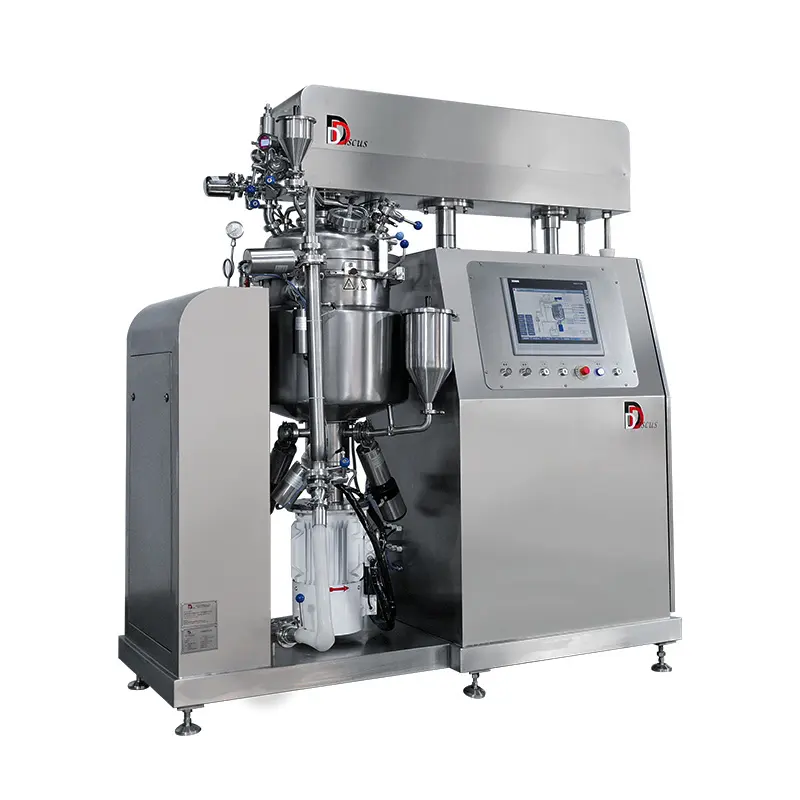
When production managers and senior formulation engineers evaluate cosmetic, pharmaceutical, or chemical processing lines, achieving absolute batch consistency is always the ultimate engineering benchmark. Running a heavy-duty vacuum homogenizer mixer machine involves navigating complex fluid dynamics, high-shear rotor-stator mechanics, and precise thermal gradients. Based on years of hands-on factory commissioning and formulation troubleshooting on active production floors, uneven mixing or poor powder dispersion can instantly compromise product stability, texture, and shelf life. Understanding the foundational fluid behavior inside a sealed mixing vessel allows technical teams to tackle dead zones, control shear rates, and optimize overall processing parameters before scaling up industrial batches.
Optimizing Rotor-Stator Geometry and Hydraulic Shear
The heart of any advanced mixing vessel lies in its high-shear homogenizing head, where the primary particle size reduction, droplet breakdown, and emulsification take place. In many standard setups, improper clearance between the rapidly spinning rotor blades and the stationary stator teeth results in erratic droplet distribution and localized clumping. According to industrial fluid mechanics standards, maintaining precise mechanical tolerances ensures that every passing fluid element experiences maximum hydraulic shear and turbulent breakdown. Furthermore, combining central anchor scraping stirrers with high-speed bottom or top homogenizers creates a dynamic dual-action mixing flow. This synergy prevents thick creams or heavy suspensions from clinging stubbornly to the vessel walls, guaranteeing uniform distribution across the entire batch from top to bottom.
The Crucial Role of Vacuum Control in Defoaming and Uniformity
Air entrapment is one of the most stubborn adversaries of mixing uniformity, frequently leading to inconsistent density, unwanted oxidation, and micro-bubbles that ruin product aesthetics and chemical integrity. Operating a vacuum homogenizer mixer machine under a deep, stable negative pressure effectively extracts trapped air and volatile gases from the formulation matrix during the blending cycle. Industrial processing research consistently indicates that maintaining optimal vacuum levels enhances liquid penetration, promotes uniform molecular binding, and prevents active ingredients from degrading prematurely. Effective air evacuation ensures that every finished container maintains a uniform specific gravity and flawless structural consistency, free of spongy air pockets.
Thermal Management and Rheological Stability
Temperature fluctuations during the emulsification and cooling phases can drastically alter product viscosity, leading to phase separation or uneven texture gradients. Managing thermal uniformity requires a multi-layered jacketed vessel design combined with intelligent temperature feedback loops. Plant operators must carefully regulate heating and cooling media flow rates to prevent thermal shock or localized overheating, especially when working with temperature-sensitive cosmetic bases or complex pharmaceutical compounds. Ensuring steady thermal transfer throughout the vessel allows the rheological properties of the batch to remain stable, promoting seamless ingredient integration and predictable end-product performance across every production run.
Preventive Maintenance and Operational Best Practices
Even the most advanced mixing infrastructure will fail to deliver consistent results if mechanical wear and calibration drift are neglected over time. Simple, disciplined operational habits safeguard long-term batch uniformity. Routine maintenance checks—such as inspecting mechanical seals for wear, verifying agitator concentricity, and cleaning residual polymer buildup from homogenizer teeth—prevent minor mechanical slips from escalating into costly batch failures. Additionally, establishing standardized loading sequences and precise mixing time logs ensures repeatability across multiple production shifts, minimizing human error and maximizing overall operational efficiency on the plant floor.
Elevating Batch Excellence Through Discus Engineering
Achieving flawless mixing uniformity and industrial reliability requires partnering with a manufacturer dedicated to precision engineering and technological innovation. Discus stands out as an industry-leading provider of advanced mixing and packaging solutions, globally recognized for designing and building sophisticated machinery tailored to rigorous international standards. Backed by decades of manufacturing expertise, robust research and development capabilities, and a steadfast commitment to quality assurance, Discus ensures that every vacuum homogenizer mixer machine delivers superior shear performance, structural durability, and absolute batch consistency. Partnering with Discus empowers global manufacturers to elevate their production lines with cutting-edge technology engineered for enduring operational success.
Table of Contents
- Understanding the Core Fluid Dynamics of High-Viscosity Emulsification
- Optimizing Rotor-Stator Geometry and Hydraulic Shear
- The Crucial Role of Vacuum Control in Defoaming and Uniformity
- Thermal Management and Rheological Stability
- Preventive Maintenance and Operational Best Practices
- Elevating Batch Excellence Through Discus Engineering