
In the cosmetics industry, tube packaging dominates for creams, serums, cleansers, and lotions. Selecting the right tube filling equipment directly affects production efficiency, product consistency, labor costs, and long-term profitability. Fully automatic and semi-automatic cosmetic tube filling machines represent two mainstream solutions, differing sharply in automation level, workflow, output, precision, cost, and applicable scenarios. This article clarifies their core differences to help manufacturers make informed decisions.
1. Automation Level & Workflow
The most fundamental distinction lies in human intervention and process integration.
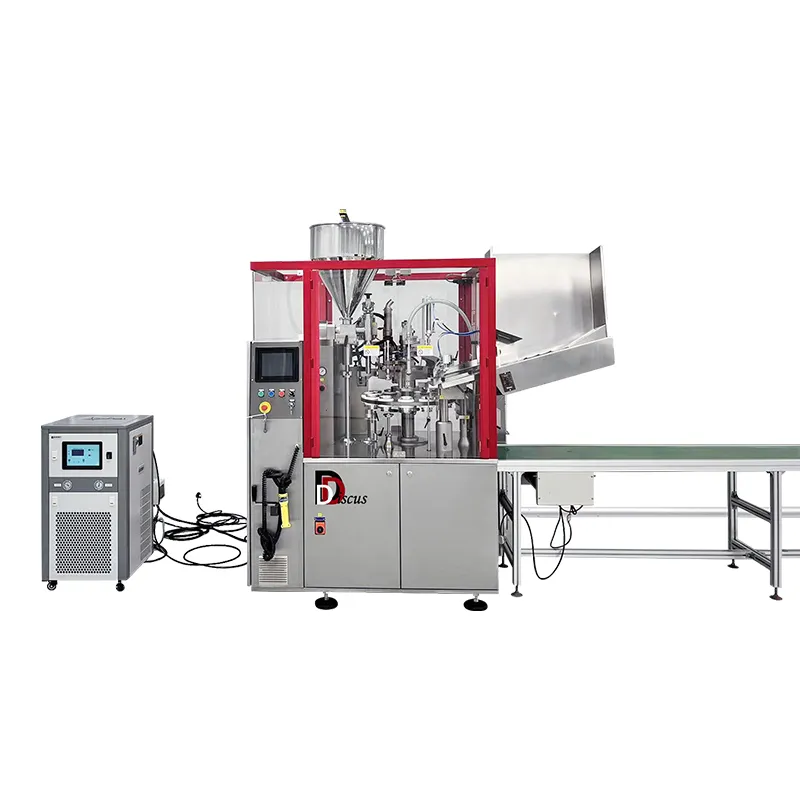
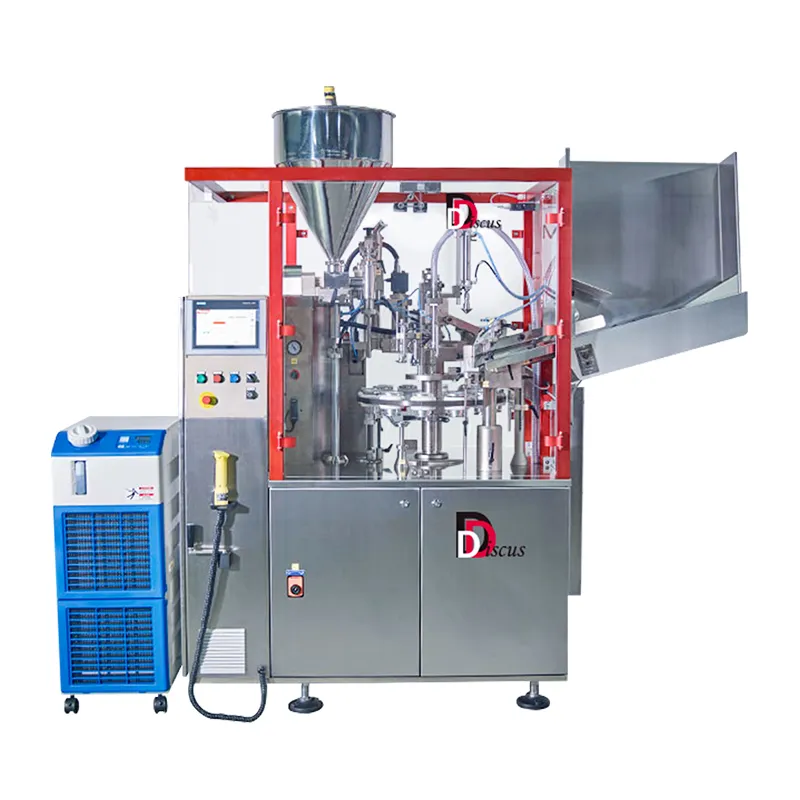
Fully Automatic Cosmetic Tube Filling Machines
These systems execute the entire production chain with minimal operator involvement. Equipped with PLC control, touchscreen HMI, servo-driven mechanisms, and photoelectric sensors, they automatically complete:
Automatic tube feeding & orientation
Color-mark alignment
Precise filling
Heat sealing / crimp sealing
Date coding & tail trimming
Finished product discharge
The entire line runs continuously once parameters are set. Only one operator is needed for routine monitoring, recipe switching, and occasional replenishment.
Semi-Automatic Cosmetic Tube Filling Machines
Semi-automatic models rely heavily on manual assistance. Operators must manually place empty tubes at the filling station, trigger the filling cycle (via foot pedal or push button), and move semi-finished tubes to the sealing station. Filling and sealing are often separate units. Basic functions like dosing are automated, but loading, positioning, transfer, and unloading require constant manual operation.
2. Production Efficiency & Output
Speed and throughput differ drastically due to automation design.
Fully Automatic Machines
Designed for high-volume continuous production, typical speeds reach 2,400–3,000 tubes per hour, with multi-station rotary models exceeding this range. They support 24-hour stable operation, eliminate manual delays, and drastically boost line efficiency. Ideal for mass production and large-scale brands.
Semi-Automatic Machines
Limited by manual handling, output is relatively low—usually 100–800 tubes per hour. Production speed depends heavily on operator skill and fatigue. They are unsuitable for large-batch orders but offer quick setup for small-batch trials.
3. Filling Precision & Product Consistency
Cosmetics demand strict dosing accuracy to avoid waste and ensure compliance.
Fully Automatic Machines
Adopt servo motor-driven piston pumps or gear pumps with closed-loop control, achieving filling accuracy as high as ±0.5% to ±1%. They maintain consistent volume across shifts, prevent dripping or foaming, and support inert gas filling (for oxidation-prone formulas). Uniform sealing appearance and stable coding quality meet high cosmetic packaging standards.
Semi-Automatic Machines
Also use metering pumps, but accuracy is affected by manual positioning and operation consistency, generally reaching ±1% to ±2%. Filling quality varies between operators, leading to possible inconsistencies in sealing firmness and tail shape.
4. Labor Demand & Operating Costs
Labor structure and long-term costs differ significantly.
Fully Automatic Machines
Require only 1–2 workers per line for supervision and maintenance. They reduce labor intensity, lower error rates, and cut long-term personnel expenses. Despite higher upfront investment, savings in labor and material waste improve ROI rapidly in mass production.
Semi-Automatic Machines
Need 1–2 workers per machine for loading, triggering, and transferring. For multi-machine deployment, labor costs rise sharply. High manual participation also increases risks of contamination, misplacement, and product damage.
5. Equipment Investment & Flexibility
Capital input and adaptability to production needs vary.
Fully Automatic Machines
Feature a complex integrated structure with high-precision components, resulting in higher upfront cost. They support fast recipe changeover via stored parameters, making them suitable for medium-to-large enterprises with stable orders, multiple SKUs, and high-quality requirements.
Semi-Automatic Machines
Have a simple structure and lower initial investment, ideal for startups, small workshops, or small-batch custom production. They are flexible for infrequent, small-scale runs but less efficient for mass or multi-variety continuous production.
6. Application Scenarios
The two systems target distinct production stages and business scales.
Fully Automatic Machines
Best for:
Medium-to-large cosmetic manufacturers
High-volume mass production
Multi-SKU, high-consistency requirements
GMP-compliant clean production
Long-term cost reduction and capacity expansion
Semi-Automatic Machines
Best for:
Startups and small-batch trial production
Low-output, multi-variety short runs
Limited initial investment
Laboratory or pilot-scale production
Conclusion
Fully automatic cosmetic tube filling machines excel in efficiency, precision, stability, and long-term cost-effectiveness, making them the first choice for scaled production. Semi-automatic machines offer lower upfront cost and operational simplicity, suitable for small-scale and initial-stage businesses.
Manufacturers should choose based on output scale, budget, product positioning, and growth plans. As the cosmetics industry pursues higher standardization and intelligence, fully automatic solutions are becoming the dominant trend to enhance competitiveness and ensure sustainable development.
Copyright © 2024 by Discus Shenzhen Co.,Ltd
 EN
EN